Sunday, June 03, 2012

Noonan jets to Bilderberg secret conference


WHY IS NOONAN AT
BILDERBERG SECRET
CONFERENCE?

Only hours after the Referendum result was declared in Dublin, Finance Minister Michael
Noonan was jetting off to the USA to attend a highly controversial and secretive meeting of
prominent figures of the global political, financial and corporate elite in a town near Washington. Noonan’s visit was unannounced and not mentioned in any Irish media. It is of some interest to the Irish people as to why their Finance Minister was attending such a meeting and what was his purpose in going there. So much for “transparency” of Government as promised by Taoiseach Enda Kenny.


The 60th Bilderberg Meeting is being held in Chantilly, Virginia, USA from 31 May – 3 June 2012. Bilderberg takes its name from the hotel in Holland, where the first meeting took place in May 1954. The original conference was held at the Hotel de Bilderberg, near Arnhem in the Netherlands, from 29 to 31 May 1954. It was initiated by several people, including Polish politicians Józef Retinger and Andrew Nielsen, concerned about the growth of anti-Americanism in Western Europe, who proposed an international conference at which leaders from European countries and the United States would be brought together with the aim of promoting Atlanticism – better understanding between the United States and Western Europe to foster cooperation on political, economic, and defence issues. Retinger approached Prince Bernhard of the Netherlands who agreed to promote the idea, together with former Belgian Prime Minister Paul Van Zeeland, and the head of Unilever at that time, Dutchman Paul Rijkens. Bernhard in turn contacted Walter Bedell Smith, then head of the CIA, who asked US President Eisenhower’s adviser Charles Douglas Jackson to deal with the suggestion. The guest list was to be drawn up by inviting two attendees from each nation, one of each to represent conservative and liberal points of view. Fifty delegates from 11 countries in Western Europe attended the first conference, along with 11 Americans.

A rare photograph of the first Bilderberg meeting at Arnhem, Netherlands, in 1954
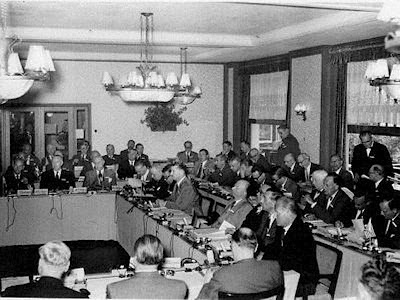


 ELITE GROUP

Historically, attendee lists have been weighted towards bankers, politicians, and directors of large businesses, in other words the global power elite.Heads of state, including Juan Carlos I of Spain and Queen Beatrix of the Netherlands, have attended meetings. Prominent politicians from North America and Europe are past attendees. In past years, board members from many large corporate trans-nationals have attended, including IBM, Xerox, Royal Dutch Shell, Nokia and Daimler.

The 2009 meeting participants in Greece included: Greek prime minister Kostas Karamanlis; Finnish prime minister Matti Vanhanen; Sweden foreign minister Carl Bildt; United States Deputy Secretary of State James Steinberg; U.S. Treasury Secretary Timothy Geithner; World Bank president Robert Zoellick; European Commission head José Manuel Barroso; Queen Sofia of Spain; and Queen Beatrix of the Netherlands.

In 2009 the group hosted a dinner meeting at Castle of the Valley of the Duchess in Brussels on 12 November to promote the candidacy of Herman Van Rompuy for President of the European Council.

The membership of the Bilderberg group is drawn largely from West European and North American countries. Writing in 1980, policy analyst Holly Sklar noted that, from the 1950s, elites in the West became concerned that the United Nations was no longer controlled by Western powers, and that this concern was expressed in the participant selection process of the Bilderberg group. Sklar also quoted observations from human rights journalist Caroline Moorehead in a 1977 article critical of the Bilderberg group's membership, who in turn quoted an unnamed member of the group: "No invitations go out to representatives of the developing countries. 'Otherwise you simply turn us into a mini-United-Nations,' said one person. And “we are looking for like-thinking people and compatible people. It would be worse to have a club of dopes.” In her article, Moorehead characterised the group as "heavily biased towards politics of conservatism and big business" and claims that the "farthest left is represented by a scattering of central social democrats".

 PROTEST

The annual off-the-record gathering of global elite in finance policy and national security is taking place behind chainlink fencing, “No Trespassing”signs and scores of local police. At the base of the driveway, the protesters congregated to denounce the meeting and shout at the occasional vehicles that entered and exited. Carrying signs with messages such as "Humanity is winning" and "Warning to secret societies: you are pissing off American patriots. One protester stated that Bilderberg meetings allow high-ranking officials to make deals away from the public eye. "It's mainly about big government contracts, for the big wigs," he said. "And then the big wigs give the government people in the revolving door jobs."

Police made at least one arrest on Friday when a young man stepped into the street, prompting condemnation from the crowd. On the whole, however, interactions between protesters and the police were peaceful. "It's just a day of work," said one officer, who insisted he was "not guarding anything", but simply protecting the Marriott's private property rights.


                       Protesters outside Bilderberg Conference, in Chantilly, Virginia, USA, yesterday.


Bilderberg critics are often labelled conspiracy theorists, particularly due to beliefs that the meeting is a sinister attempt by the global elite to concentrate power and establish a global government. But, protester Max Dickstein insists the summit merits scrutiny:

Dickstein, from New York City, lived two blocks from 7 World Trade Center, which collapsed on September 11 2001, though it was not struck by an airplane. His uncle was killed in the attacks. Dickstein was 12 years old at the time. Explanations for the collapse did not sit right with him. "I couldn't really trust any narratives," he said. "Two planes hit three buildings. That doesn't add up to me. I felt an obligation to this movement," he said. For Dickenstein, the fact that so many powerful figures meet at Bilderberg in a fashion that lacks transparency leaves him wondering, "Do people at this meeting know something I don't?"

Participants in this year's meeting reportedly include Massachusetts Senator John Kerry, Indiana Governor Mitch Daniels, War Criminal Henry Kissinger, senior officials from a number of the world's largest banks, the co-founder of LinkedIn and a member of the Syrian National Council, among others. As well as Michael Noonan, other known attendees from Ireland are: Paul Gallagher, - former Irish Attorney General and Senior Counsel, Peter Sutherland,- former Irish Attorney General, now Chairman of Goldman Sachs International.

From Britain are:

Marcus Agious - Chairman of Barclays Pls
Nick Boles - Member of Parliament
Kenneth Clarke - Member of Parliament, Lord Chancellor, Secretary of State for Justice.
Robert Dudley - Group Chief Executive BP Plc
Douglas Flint - Group Chairman HSBC Bank Holdings
John Kerr - Independent Member House of Lords
Peter Mandleson - Member House of Lords, Charman of Global Counsel
John Micklethwait - Editor in Chief, the Economist
Peter Voser - CEO Dutch Shell Plc

The Conference as announced on their website will deal mainly with political, economic and societal issues like Transatlantic Relations, Evolution of the Political Landscape in Europe and the US, Austerity and Growth in Developed Economies, Cyber Security, Energy Challenges, the Future of Democracy, Russia, China and the Middle East, but many critics believe that secret arrangements are made to coordinate strategies by Governments and leading bureaucrats such as Rompuy and Barrosso from the EU which would favour only the interests of the elite.

The attendance of many military figures from NATO at these conferences and the hostile
Anti-Soviet and anti-Communist tone of the rhetoric emanating from the Bilderbergers since the first meeting in 1954 when the Cold War was well underway, suggest that the organisation is a prop for NATO, propagandising the so-called “Western” values often put forward as a cover for NATO aggression as we have seen more recently in the bombing of Yugoslavia in 1999 and the invasions of Iraq, Afghanistan, Libya and currently the attempts to destabilise the Assad government in Syria. Coupled with the attendance of the corporate elite from those companies which make huge profits from military contracts and “security” missions in various countries where NATO aggression takes place it seems that
this is the real role of the Bilderberger gatherings.


FearFeasaMacLéinn
Áth Cliath/Dublin 03 Meitheamh/June 2012.


Saturday, June 02, 2012

Irish Poll result doesn't halt struggle


POLL RESULT A SETBACK
BUT STRUGGLE GOES ON:


The result of the Irish referendum
on the EU Austerity Treaty is a
disappointment but, the struggle
for a Democratic and Social Europe
will continue and intensify. Resistance
is strong and growing all over Europe:


Statement from the Campaign Against Austerity Treaty:


Irish people bullied into voting Yes

Referendum result is not a mandate for home and water taxes

Labour's way IS Frankfurt's way


The government and the EU have succeeded in bullying the people of Ireland into voting for a Treaty they do not want. This vote was based upon fear and the Yes majority is a hollow victory. Even amongst supporters of the Treaty there was an admission that the only grounds for supporting it were the threats of exclusion from future bailout funds. This was the only substantive argument presented by the government and the Yes campaign.

The referendum result today should not be regarded as a mandate to impose the household tax, the water tax and other austerity measures. Those who are being most effected by the austerity measures – cuts and tax hikes – have rejected this treaty in large numbers.

Labour's way is now exposed as Frankfurt's way: the protection of failing banks at the expense of ordinary working people. The Labour Party should take no comfort in this result. They will find themselves supporting cuts and taxes that impose the burden of the banking and economic crisis on ordinary people. The Austerity Treaty, and the austerity policies being currently implemented, will bring neither stability, recovery nor growth. Labour supporters will soon realise this.

Over the coming months the activists of the Campaign Against the Austerity Treaty will work with those who oppose the implementation of the austerity measures that are embodied in this anti-social treaty. We will continue to link up with like-minded movements across Europe in support of an alternative that prioritises full employment, social protection, peace and environmental sustainability.


Dr Andy Storey, BA, M Litt, Phd. University College Dublin, comments:


"The fiscal treaty was voted on in a referendum in Ireland yesterday and was approved by a margin of 60% to 40% (with a turnout of barely 50% of eligible voters). 


The outcome of the referendum was largely attributable to the ‘yes’ side’s focus on Ireland’s access to the new European Stability Mechanism (ESM) – the fund to which Ireland would be expected to apply should it require a second loan from non-market sources (a first such loan – from EU, IMF and other sources – was contracted in 2010).  The argument was endlessly repeated that a ‘no’ vote would deny Ireland the ability to apply to the ESM, and many people were doubtless convinced that this could be a risky proposition .  Thus, the ‘yes’ vote is explained to some extent not by any widespread endorsement of the content of the treaty itself, but rather by an explicit campaign of blackmail waged against potential ‘no’ voters.  As Paul Murphy, Socialist Party Member of the European Parliament put it, a ‘yes’ vote  is “no endorsement of what’s in this treaty and it’s no endorsement of austerity. People are scared out there.”


Things, however, will not get better or less scary for most Irish people any time soon.  In fact, they will likely get worse.  A ‘breaking news’ headline in one of the country’s national newspapers this morning  read: “Bad news back on agenda now vote is over”, referring to the fact that issues such as the introduction of new taxes, discussion of which was cynically deferred during the referendum campaign, will come roaring back with a vengeance. 
Further swingeing austerity is to be imposed for years to come, copper fastened in place by the treaty’s rules.  Those who have borne the brunt of the cutbacks to date already understand this – working class communities tended to vote ‘no’ to the treaty, while the ‘yes’ vote was highest in middle- and upper-class constituencies; even one government minister conceded that the vote reflected a “class divide”.


There is no disguising that the referendum result is a disappointment. However, the fact that the ‘no’ vote was 40% is, under the circumstances, a very decent showing, especially given that the three largest political parties (only two of which are in government), all major newspapers, business groups and various civil society elites were unanimous in their calls for a ‘yes’ vote.  And it is worth bearing in mind that the fear factor discussed above pushed a lot of people into the ‘yes’ camp despite their opposition to the broad thrust of current policy.  Nor can those who abstained be counted as having given the current regime a ringing endorsement.  In other words, almost the entire weight of establishment Ireland could barely manage to persuade 30% of the electorate to back the treaty, and a good number of those did so only through gritted teeth and at effective gunpoint.  The courage of those who voted ‘no, coupled with what will inevitably be the growing anger and sense of betrayal felt by many of those those who voted ‘yes’ or who did not vote at all, provides a solid basis for developing a serious alternative agenda to, and mobilization against, the debt and austerity programme in the years to come." 


Labour straws in wind:

Five constituencies of of 43 voted NO; Donegal North-East, Donegal South-West and
three in Dublin:  Dublin North-West, Dublin South Central and Dublin South-West. The Dublin NOs are significant for the Irish Labour Party as each elected 2 Labour representatives in last year’s General Election and each has a heavily working-class electorate, Labour’s natural constituency.


FearFeasaMacLéinn
Áth Cliath/Dublin 03 Meitheamh/June 2012.


Wednesday, May 30, 2012

German call for renewal of EU


GERMAN ACADEMICS AND TRADE UNION
LEADERS CALL FOR EU RENEWAL:


Founding Europe anew!


Initiators:
Frank Bsirske (Ver.di)
Annelie Buntenbach (DGB)
Prof. Dr. Rudolf Hickel (Wirtschaftswissenschaftler)
Dr. Steffen Lehndorff (Sozialwissenschaftler)
Dr. Hans-Jürgen Urban (IG Metall)

Stop the March into Ruin! Overcome 
the Crisis with Solidarity!


This way of austerity cannot and should not continue. The project of Europe is in impasse. Europe finds itself in an existential crisis. Even before the outbreak of the crisis the directions were set in a wrong way, because the Euro-construction was fixed unilaterally on monetary stability and flawed debt- and deficit criteria, through a wrong economic and political coordination and a grave neglect of the social union. The crisis was pushed forward through neo-liberal deregulation politics and unscrupulous greed of the financial elite speculating against countries in crisis and wanted to force a financial market conformity.

With the neo-liberal model of subordination under the dominance of the (financial)markets, the EU does not add to a solution but an aggravation of the crisis. Instead of naming political mistakes and greed for profits as the causes of the crisis, state deficits are
being redefined into at (social) sovereign debt crisis in order to legitimise a disastrous politics. Public expenditures as well as work- and social incomes are radically cut through by injunctions; wage earners, unemployed and pensioners are made to carry the costs of bank saving procedures.

Thereby especially the economic regulations (»Economic Governance«) and the fiscal pact pushed through by the German government follow an agenda which threaten to endanger social democracy of member states in irreparable ways. This kind of politics is irresponsible and must be terminated immediately.  It is economically and politically contra-productive because it strangles private and public consumption as well as public investments and thus growth and development; socially irresponsible because it deepens the gap between member states, also within countries themselves.Its effects on democracy are destructive because it dismisses democratic procedures and attacks achievements of social democracy long struggled for such as autonomy in wage bargaining and social protection systems.

In the case of Greece the catastrophic consequences of this politics are appearing in sharp focus here, the economy was forced into a recession while large parts of the society are impoverished, more and more people turn their backs from Europe with feelings of bitterness, and democracy is choked in the grip of the “Troika”.This development in Greece must be stopped and shall not – by no means whatsoever –  be repeated in other countries! Europe must embark on a new road of development. If it wants to have a future as a project of democracy and solidarity, political directions must be set in completely new ways. As the economically and politically strongest member state, Germany carries a special responsibility. We are demanding from German politics that it may no longer not act as the thriving force of a destructive crisis politics but as a marker of a change of path which is long overdue.

The following economic and political measures are most urgent:  

Financial transactions must be taxed drastically.

Financial market players must, as culprits of the crisis be held accountable 
for the financing of a solution to the crisis.

The financial markets must be regulated and the banking sector must be restructured .  

For government bonds the Euro-zone must jointly guarantee and state finances must be decoupled from capital markets.

European monetary politics has to become entrusted, aside of money-stability as a goal, with targets of growth and employment political goals.

German unions and the political sphere are being challenged. In Germany. Wages must increase again as they have done in previous years, in order to put an end to the steady redistribution in favour of income of financial,bank and shareholder profits and to work against the imbalances within the EU. Equally important is an encompassing re-regulation of the working markets and a reduction of the low- income sector as well as precarious work (working conditions).

However, these measures do not suffice. A change of path has as a prerequisite a set of fundamental changes:  

In order to enable cooperation of differently productive economies under a common roof of
the Euro, it is necessary that the EU develops further into a transfer-union. Equalization
payments help to decrease existing economic imbalances within the Euro-zone. 
Thereby duties and rights of giving- and taking states must be commonly agreed upon.

New developmental perspectives must be opened for states with high debts through aid programs.  Europe needs a democracy-offensive. The EU will have no positive future as a detached elite- project. Political directions of change must be executed solely under the strict adherence toEuropean treaties and institutions. Governments have no mandates to promote crisis politics aside of avoiding parliaments. Europe‘s populations must be involved concerning all core questions.  

Europe must found itself anew! The unification process needs a guiding idea constituting identity. More and more people associate Europe today with state debts, social decline, and bureaucracy .They divert their sympathy and consent from the EU. If Europe is to have a future at all, Europe must work actively for the consent and sympathy of the people. In European public life most main actors have to negotiate the guiding ideas for a social and democratic Europe.

We plead for a European social movement of citizens which embarks on a radical change of path, and acts against the current disastrous crisis politics. A first step on this road must be the rejection of the Fiscal Pact in its current form, and new negotiations on fiscal and political frameworks. We appeal to all main political actors responsible,  to unions and civil society: The path of Europe into ruin must be stopped – through more economic wisdom, social justice, and democratic courage! Europe needs a public debate about a new democratic future of solidarity!


Signatories:

Prof. Dr. Elmar Altvater (Sozialwissenschaftler)
Prof. Dr. Hans-Jürgen Bieling (Sozialwissenschaftler)
Prof. Dr. Gerhard Bosch (Sozialwissenschaftler)
Prof. Dr. Ulrich Brand (Sozialwissenschaftler)
Prof. Dr. Klaus Busch (Sozialwissenschaftler)
Prof. Dr. Frank Deppe (Sozialwissenschaftler)
Prof. Dr. Klaus Dörre (Sozialwissenschaftler)
Christoph Ehlscheid (IG Metall)
Prof. Dr. Andreas Fisahn (Rechtswissenschaftler)
Edith Großpietsch (IG Metall)
Prof. Dr. Jürgen Habermas (Philosoph)
Dr. Dierk Hirschel (Ver.di)
Dr. Martin Höpner (Sozialwissenschaftler)
Dr. Gustav Horn (Wirtschaftswissenschaftler)
Alexander Kirchner (EVG)
Prof. Dr. Birgit Mahnkopf (Sozialwissenschaftlerin)
Claus Matecki (DGB)
Franz-Josef Möllenberg (NGG)
Jürgen Peters (IG Metall)
Klaus Pickshaus (IG Metall)
Wolfgang Pieper (Ver.di)
Prof. Dr. Dieter Sauer (Sozialwissenschaftler)
Armin Schild (IG Metall)
Dieter Scholz (DGB)
Dr. Thorsten Schulten (Sozialwissenschaftler)
Prof. Dr. Michael Schumann (Sozialwissenschaftler)
Michael Sommer (DGB)
Franz Steinkühler (IG Metall)
Ulrich Thöne (GEW)
Dr. Alexandra Wagner (Sozialwissenschaftlerin)
Detlef Wetzel (IG Metall)
Klaus Wiesehügel (IG BAU)
Bernhard Witthaut (GdP)
Dr. Frieder Otto Wolf (Philosoph)
Prof. Dr. Karl Georg Zinn (Wirtschaftswissenschaftler)


http://www.youtube.com/watch?v=gNa5k0KCVbw


FearFeasaMacLéinn
Áth Cliath/Dublin 30 Bealtaine/May 2012.

Irish EU Referendum battle intensifies


REFERENDUM BATTLE
CLOSE FOUGHT
TO BITTER END:


The Irish Referendum campaign on the EU Austerity Treaty is being fought
tooth and nail in the final days before voting on Thursday. Door to door canvas
will continue until late evening today in all areas. World media have been arriving
in force since last week and citizens are likely to be invited to comment for
Japanese or Swiss television viewers as they go about their business on the
streets of Dublin.

In the past week, solidarity actions have been taking place outside Irish Embassies
In Rome, Lisbon, Helsinki, Madrid, The Hague, Vienna and Brussels where 
statements were handed in urging Irish people to vote NO on behalf of Europeans 
deprived of an opportunity to vote by their own governments in the setting aside of 
democracy which characterizes the current EU.

Tuesday night’s RTÉ “Prime Time” debate on television on the Referendum was a disaster for the ‘Yes’ side. Clare Daly,TD, Socialist Party and Mary Lou McDonald,TD, Deputy Leader of Sinn Féin, fresh from a successful Ard-Fheis (annual conference) in Killarney at the weekend, wiped the floor with the two ‘Yes’ supporters, Joan Burton, TD, Deputy Leader of the Irish Labour Party and Timmy Dooley, TD, of Fianna Fáil, the previous government party ousted in the 2011 general election.

Ms Daly and Ms McDonald pinned down the lies and falsehoods of the ‘Yes’ campaign with forensic detail and demolished the pathetic attempts of the other two to defend the contradictory stance of the pro-Treaty campaigners in wanting to commit the nation to a vicious austerity regime with no democratic accountability while mouthing hollow slogans about “growth and recovery” which can never be provided by such a regime.

Joan Burton, who is also Minister for Social Protection, looked distinctly uncomfortable as she tried to stave off criticism which exposed the glaring contradictions of the government position and her own departmental brief which will become practically irrelevant if the Austerity Treaty is incorporated into Irish law. Mr Dooley, a light-weight in the FF front bench, with no credibility on economic matters, floundered and blustered in a welter of redundant clichés showing no knowledge of the matters being discussed and the absence of any coherent policy by his party, Fianna Fáil, in the wake of their disastrous government performance 2007-11.

Earlier today, in the High Court in Dublin, Sinn Féin leaders launched a challenge to the Referendum Commission’s declaration last week that Ireland could not veto the setting up of
The European Stability Mechanism (ESM) the legislation for which comes before Dáil Éireann after the referendum. It is important that the voters have correct information before the poll on Thursday and as explained here yesterday, Dáil Éireann has every Constitutional right to veto this proposed legislation.


WHAT THE AUSTERITY TREATY MEANS:


The proposed Treaty on Stability, Co-ordination and Governance in the Economic and Monetary Union is in reality a permanent Austerity Treaty. A completely undemocratic attempt to institutionalise austerity across Europe. Its so-called 'Fiscal Compact' would deny the right of Member State governments to run a 'structural' budget deficit of more than 0.5%. This would remove the democratic right of national parliaments to decide national budgets, with that power shifting to the unelected European Commission and European Court of Justice. This would be a fundamental transfer of power away from elected governments.

The demand for “balanced budgets”, and fines of hundreds of millions of euro for countries which breach EU targets, is an attempt to impose austerity regardless of what government is elected or what mass movements against austerity develop. This attack on democratic rights is part of the same process that has seen elected governments in Greece and Italy replaced by ex-bankers, who represent the interests of the powerful and wealthy.

The proposed Austerity Treaty will not revive the economy or reduce unemployment. It would result in a Europe where millions are out of work for years; where welfare and other benefits are driven down; where education, health and other essential services are cut. It would exacerbate the differences between rich and poor, and between the wealthy core and indebted peripheral countries - shifting the burden of the crisis onto ordinary people.

The proposed Austerity Treaty is a means to compel governments to reduce public spending so as to pay public debt. But public debt has grown because banks have been given €billions to stop them collapsing or because the rich paid little or no tax – not because of excessive spending on public services. Yet the banks and financial markets now insist that governments must become more “credit-worthy”: spending cuts are demanded - to ensure that the state can pay debts that were taken on to bail out the banks in the first place.

Cutting public spending on health, education and welfare will only make the current crisis worse. The economy is in recession, yet €billions of accumulated profits are not being invested productively. Instead, money has gone into financial speculation, which is at the root of the financial crisis and has fuelled the growth of huge debt on the part of households, businesses and states. Therefore it can be seen as a clear agenda for the complete dismantling of the welfare state across Europe by disabling democratic decision making in state parliaments and enforcing a bureaucratic regime from Brussels which would be unaccountable and uncontrollable by any democratic means. It wouldn’t matter what government was elected, they would be unable to alter the legally binding Austerity Treaty and would be forced to continue with the right-wing neo-liberal ‘necronomics’ policies of stagnation and public spending cuts which has been the bureaucrats and the financial elite’s plan all along.

In the past, recession and a refusal to invest profits were addressed by state investment in public works. But the Austerity Treaty would prevent states from running deficits to fund public works; it would further reduce economic demand and risks turning the current recession into a long-term depression.

The decision on the Austerity Treaty is about the kind of Europe we want: a Europe for the millions or for the millionaires. The real issue in a referendum will not be the euro or membership of the EU. It will be a choice between accepting an EU Austerity Union, with protection for the wealthy and poverty for ordinary people; or struggling with others across Europe for a People’s Europe, where the priorities are democracy and equality, full employment, social protection and sustainable development.  

What has been imposed on Greece is exactly what is intended for all of 
Europe by the league of Liars, Thieves and Traitors who are 
propagandising  for this Treaty.


FearFeasaMacLéinn
Áth Cliath/Dublin 30 Bealtaine/May 2012.